
In his address, the air chief marshal underlined that with a massive surge of new technologies and opening up of space to private players, there is a "disruption in the established scheme of things".

The reality is that far from being friendless, India is better positioned in the world than at any point post-Cold War, asserts Shekhar Gupta.

A new book reveals that India and Pakistan discussed a communal division of Jammu & Kashmir along the Chenab river before the Kargil war in 1999.

Sholay's Basanti is the face of women's empowerment and gender equality. That's why, half a century after the movie first released, we're still talking about her.
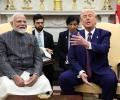
'Trump's aggressive stance towards China and preference for military posturing could shift the Quad's balance towards overt militarisation.'

'There's no pro-China tilt in BRICS.' 'All these countries want to be close to China, but they are all good friends of India also.'
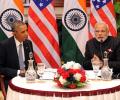
India has moved beyond the traditional trappings of non-alignment

'Despite being a software powerhouse, we're not producing proportionate original IP, frameworks, or global tech products originating in India.'

As Donald Trump registered a historic comeback in the US presidential election, many former Indian diplomats on Wednesday concurred that the India-US ties will "continue to grow" from strength to strength, even as some of them cautioned that Trump is "highly unpredictable" and New Delhi will have to "wait and watch" to see what position he adopts going forward.

Many were hoping that with Vajpayee's NDA gone, there would be a return to the Congress normal. Nobody was prepared for the opposite. Sonia Gandhi was sceptical. This became the only issue over which Manmohan Singh took on his party bosses and risked his government. Politically, it was riskier than the 1991 reform, recalls Shekhar Gupta.

External Affairs Ministry spokesperson Randhir Jaiswal said India has a long-standing relationship with Russia which is based on "mutuality" of interests.

In retrospect, it appeared that the bitterness of the war was still strong and the Ukrainian success in occupying Russian territory just a few days ago had added to the complexity of the situation. The positive US response to the visit, however, remains a silver lining in the dark clouds, notes Ambassador T P Sreenivasan.
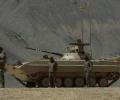
Chief of Defence Staff Gen Anil Chauhan on Tuesday underlined the evolving nature of warfare and said a combat has always been between humans but now the world is going to enter an era in which it may be between a machine and human being and later between machines.

"India's historic leadership of the non-alignment movement and desire to maintain strategic autonomy somewhat constrain cooperation at a level USPACOM (US Pacific Command) desires," the US Pacific Command Commander Admiral Robert Willard said in his testimony before House Armed Services Committee.
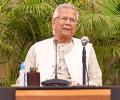
The chief adviser's decision to stay in office came two days after he told student-led National Citizen Party (NCP) leaders that he was mulling resignation as he felt "the situation is such that he cannot work", citing difficulties in working amid the failure of political parties to find common ground for change.

Reports (not denied by India) that the USA had 'for the first time provided real-time details to their Indian counterparts on the Chinese positions and force strength in advance of a PLA incursion' into Tawang at the LAC in December 2022, helping India thwart China's expansionist designs, show how operationally effective the USA-India friendship has become on the ground. A engaging excerpt from Sreeram Chaulia's must-read new book, Friends: India's Closest Strategic Partners.

'India has a strong and proud tradition of strategic autonomy, and we respect that'

Times have changed, situations have changed, but the basic nature of superpower geo-politics remains the same and so also India's diplomacy -- call it non-alignment, strategic autonomy or neutrality; it all depends on the time scale, notes Rup Narayan Das.

EAM Jaishankar's mission is aimed at strengthening India's strategic autonomy in a complex international environment, observes Ambassador M K Bhadrakumar.

'As the global economy undergoes significant transformations in 2025, India's ability to navigate the complexities of trade wars, financial realignments, and emerging blocs will be pivotal,' explain Harsh V Pant and Soumya Bhowmik.

India is increasingly a willing participant in the evolving US' Indo-Pacific strategy. While these developments are related to the perception of a growing Chinese security challenge, their implications for India's much-vaunted strategic autonomy should be a matter of deeper and closer reflection, asserts former foreign secretary Shyam Saran.

The Union government is expecting to rake in Rs 100-200 crore in additional revenue from Pillar Two, only under specific circumstances, a senior finance ministry official said requesting anonymity. It is proceeding cautiously, and is unlikely to implement rules anytime soon, the source said.

India would not be seen to be anything but rude with the Pakistanis. In the big picture, who is the bigger adversary right now? Who is the bigger pain in the neck? And who is it that is keeping more than 3,000 km of our borders active, throwing our military posture and deployments into imbalance? asks Shekhar Gupta.

Micromanagers feel the need to be involved in every decision, hence they will avoid delegating tasks and spend a lot of time focusing on minor details rather than the bigger picture, says Sonica Aron, founder of the HR consultancy firm, Marching Sheep.

The compulsion behind India and Japan to deepen security cooperation is in response to China's growing political and economic clout and its assertive behaviour in disputed areas. This has been the key driver for bringing both India and Japan closer in the domain of security cooperation, explains Dr Rajaram Panda.

The fundamental construct of India's neighbourhood policy still needs to be what Vajpayee postulated, Manmohan Singh embraced, and Modi energised. It's just that we need to junk domestic politics and excessive religiosity, while acquiring much humility and a renewed respectfulness towards our neighbours, recommends Shekhar Gupta.
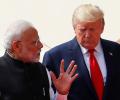
Delhi's appeasement strategy may now translate as more mega arms deals with the US, generating substantial business and job creation in the American economy. Make no mistake, Americans will use it to pressure India, predicts Ambassador M K Bhadrakumar.

The Indian position on the Russia-Ukraine war and the unconditional treaty between China and Russia appear to have caused some ripples in India-US relations and led to a reappraisal of India's usefulness to the US in the eventuality of a conflict with China, notes Ambassador T P Sreenivasan.

The National Security Strategy document should flag all major issues concerning security strategy and provide guidelines to concerned departments to work out suitable action plans. Since the global and regional geopolitical canvas is dynamic, the NSS document should be deliberated at length before formulation and should be reviewed periodically, recommends Commodore Venugopal Menon (retd).
the Opposition on Thursday demanded a passage of a resolution in the Rajya Sabha to reflect the sense of Parliament that country's nuclear and strategic autonomy is not compromised.

Pitching for increased foreign investment for a growth of 9 to 10 per cent, Prime Minister Manmohan Singh on Monday said India will have to pay more attention to the Asia-Pacific region but asserted that the country's "strategic autonomy" would not be compromised.

It's intriguing that the prime minister now wants his American partner to help protect the Hindu minority in Bangladesh. That's conceding to the Americans a pre-eminence India has always contested, resented and feared, asserts Shekhar Gupta.
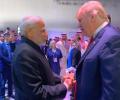
'India will come increasingly in the US crosshairs if it insists on maintaining its strategic autonomy, warns Ambassador M K Bhadrakumar.

The central government's Great Nicobar development project, proposed around an unprecedented transhipment port, will be executed to keep environmental impact minimal, and is essential as it is of national importance, the government has said amid calls to abort the controversial project due to ecological concerns, the Centre said in an official statement.
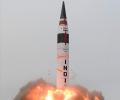
Maintaining that its strategic capabilities were not targeted against any particular country, India has said that it abides by all applicable international obligations and expects others do the same, while responding to Chinese reaction to its test-firing of Agni V missile.

India's voting pattern in the United Nations with regard to the Israel-Palestine conflict is lately marked by a calibrated distancing from Israel, observes Ambassador M K Bhadrakumar.

"We work with other countries to develop their capabilities and support their efforts to make free sovereign choices. More broadly, we aim to advance peace and stability in the region," he asserted.

Chinese Ambassador Sun Weidong has said peace and tranquility in the border areas with India is important but it is not the "whole story" of the bilateral relations and that the current status of the ties is obviously not in the fundamental interest of either side, remarks that came amid the Ladakh military standoff.
Progress on the steps taken by Governor Shaktikanta Das' predecessor Urjit Patel to restore financial system integrity will be a key thing to assess any damage to the institution, Subramanian said.

'While the US-Pakistan relationship has been stabilised, it's still mired in uncertainty.'
